
In two large tech layoffs, about half of the people who left had started a new job within three months. That was true at Block in 2026 (52%) and at Google and the rest of Alphabet in 2023 (51%). When people left the same companies in normal periods, 63% to 71% had a new job within three months.
On February 26, 2026, Block told shareholders it was "reducing Block by nearly half, from over 10,000 people to just under 6,000, which means that over 4,000 people are being asked to leave or entering into consultation" (Block's Q4 2025 shareholder letter). In January 2023, Google said it would "reduce our workforce by approximately 12,000 roles" (Sundar Pichai's memo).
We used our own employment data to see where those people work now, and compared them with people who left the same companies in quieter months.
In both layoffs, about half had a new job within three months
| Group | People | New job within 3 months | New job within 6 months |
|---|---|---|---|
| Left Block, Feb to May 2026 (layoff) | 2,438 | 52% | 66% |
| Left Block, Jul to Sep 2025 | 387 | 63% | 71% |
| Left Block, Oct to Dec 2024 | 370 | 68% | 79% |
| Left Alphabet, Jan to Apr 2023 (layoff) | 15,183 | 51% | 62% |
| Left Alphabet, Jan to Apr 2022 | 10,172 | 71% | 76% |
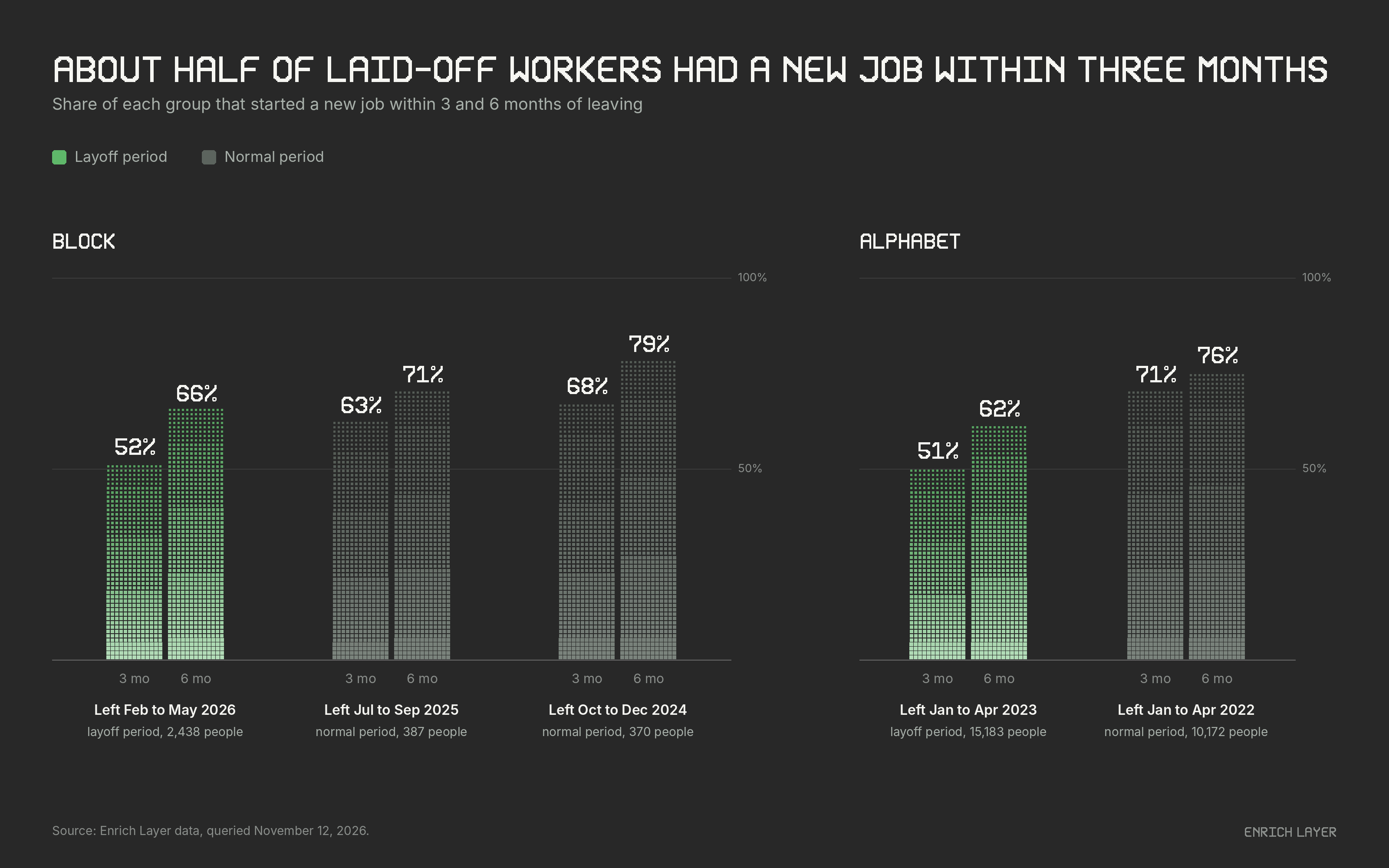
The gap is wider for people who left Block in February and March, at the start of the layoff. Of those 1,426 people, 42% had a new job within three months, against 67% of people who left in July and August 2025.
At six months, the gap is smaller at Block (66% against 71%) and still wide at Alphabet (62% against 76%). The six-month figures for the 2026 group are likely to rise. For people who left in May, the six-month window was still open when we ran the queries, and recent job changes take time to appear in our data.
The way the layoffs were run may explain part of the gap. Google said it would pay US employees "during the full notification period (minimum 60 days)," and Block said its costs would be mostly "cash expenditures for notice period and severance payments" (Block's 8-K filing).
Someone on paid notice may list the month they were told as their end date and start a new job months later. When people left Block in a normal quarter, the median person started a new job in the same month they left, which suggests many had the next job lined up. Our data shows the delay. It doesn't show how much of it was choice and how much was a hard job market.
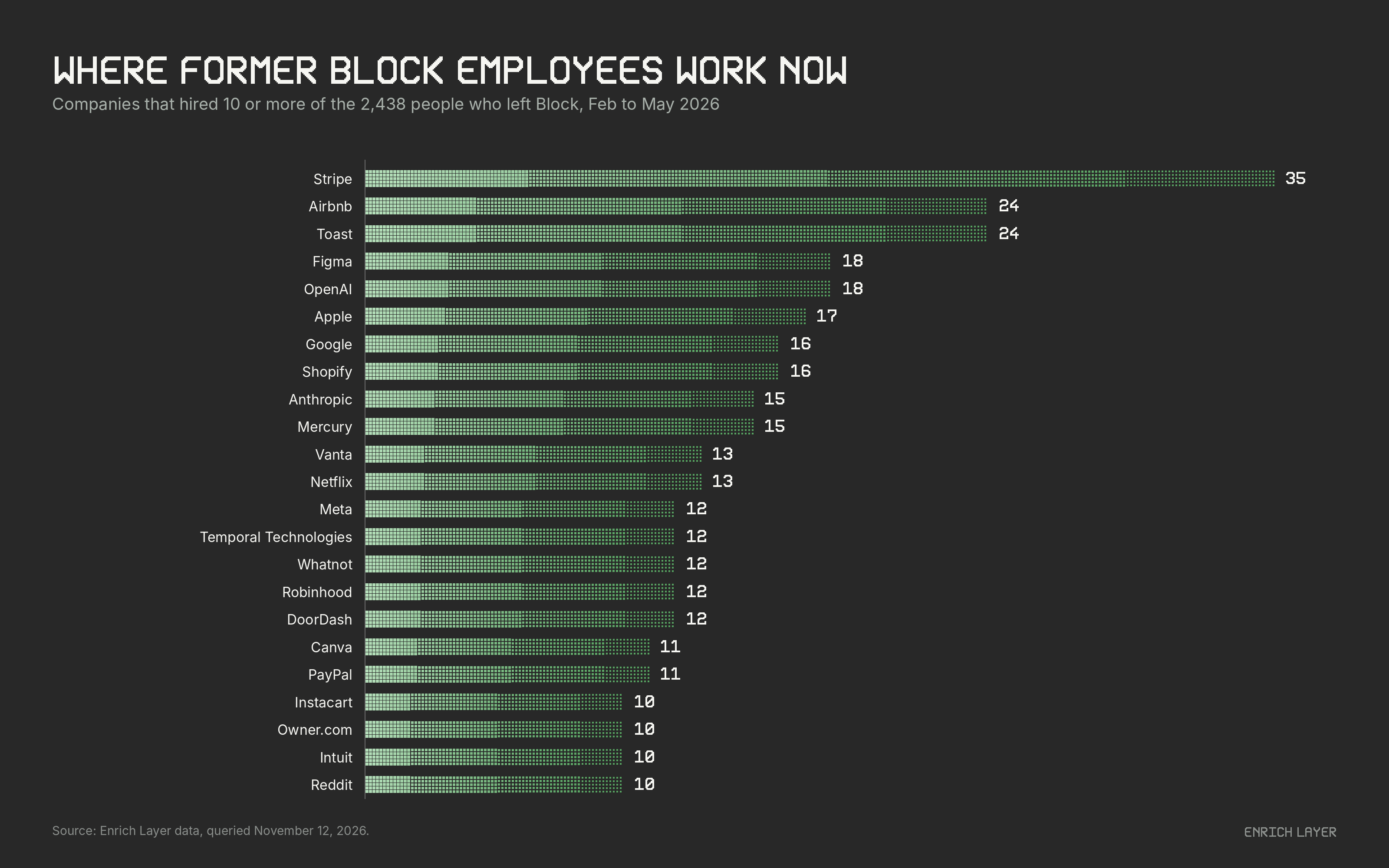
Stripe, Airbnb, and Toast hired the most former Block employees
After the Block layoffs, 1,625 of the 2,438 people who left Block, Square, Cash App, Afterpay, and TIDAL between February and May 2026 now list a new job at another company. Twenty-three companies each hired 10 or more of them.
| Company | Former Block employees |
|---|---|
| Stripe | 35 |
| Airbnb | 24 |
| Toast | 24 |
| Figma | 18 |
| OpenAI | 18 |
| Apple | 17 |
| 16 | |
| Shopify | 16 |
| Anthropic | 15 |
| Mercury | 15 |
| Vanta | 13 |
| Netflix | 13 |
| Meta | 12 |
| Temporal Technologies | 12 |
| Whatnot | 12 |
| Robinhood | 12 |
| DoorDash | 12 |
| Canva | 11 |
| PayPal | 11 |
| Instacart | 10 |
| Intuit | 10 |
| Owner.com | 10 |
| 10 |
Note the payments and fintech companies here. Stripe, Toast, Mercury, Robinhood, and PayPal together hired 97 people, or 6% of everyone with a new job. OpenAI and Anthropic hired 33 between them.
Most people went to established companies. Of the 1,625 with a new job:
- 53% joined a company with more than 1,000 employees.
- 15% joined a startup (our definition is in the method section).
- 5% joined one of the largest tech companies: Alphabet, Amazon, Apple, Meta, Microsoft, Nvidia, or Netflix (including their subsidiaries).
- 4% listed a stealth company or an employer we couldn't identify.
Another 37 people (2%) list a founder or co-founder title at their new job.
People who left Block in a normal quarter chose similar employers. Their first new jobs were at startups 13% of the time and at the largest tech companies 5% of the time, close to the layoff group's 15% and 5%. Where the two groups differed was timing.
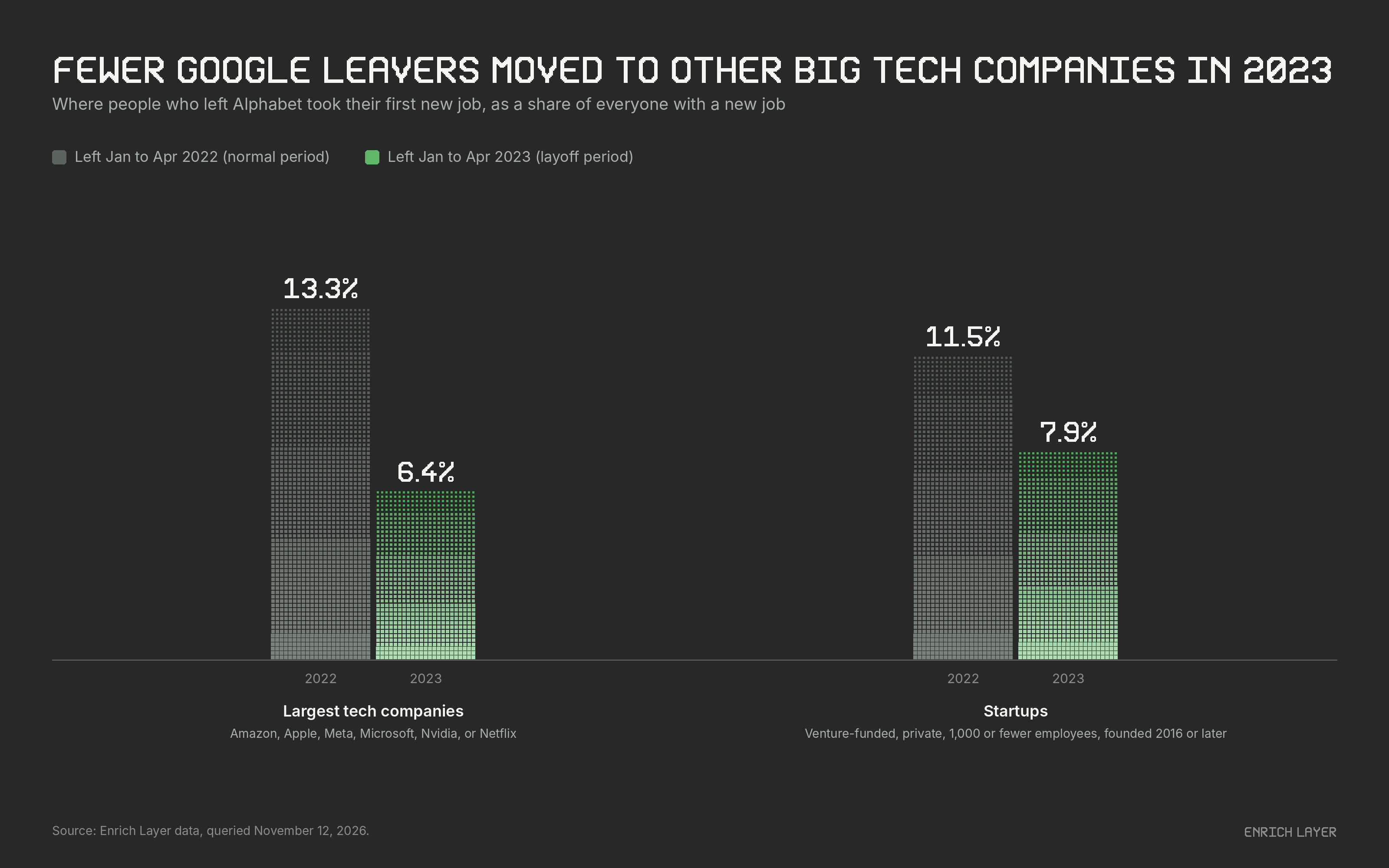
In 2023, fewer Google leavers moved to other big tech companies
The Alphabet group shows a second change. Their first new job was at Amazon, Apple, Meta, Microsoft, Nvidia, or Netflix 6.4% of the time, against 13.3% for people who left in early 2022. Startups took 7.9% of the 2023 group and 11.5% of the 2022 group.
Meta was still the most common next employer in both years. More than three and a half years after the 2023 layoff, 662 people from that group work at an Alphabet company again.
How we counted
Data. We used the work history in Enrich Layer's people data and company data. Enrich Layer uses public data and third-party vendors. We ran every query on November 12, 2026. The numbers describe work history as it appeared in our data on that date.
Who's in each group. A person is counted if a job at the company ended in the stated months, they had held that job for at least three months before the period began, and the job title isn't an internship, contract, or temporary role.
Moves between companies in the same group (for example, from Square to Cash App, or from Google to YouTube) don't count as leaving. The Block group covers Block, Square, Cash App, Afterpay, and TIDAL. The Alphabet group covers 17 Alphabet companies, including Google, YouTube, Google DeepMind, and Waymo.
Why these months. Block announced its layoff on February 26, 2026, and said the plan would be "substantially complete by the end of the second quarter of fiscal 2026." Role endings in our data rose sharply in February and again in May, so the 2026 group covers February to May.
For Google, US employees were paid through a notice period of at least 60 days, and the memo said the process would take longer in other countries, so the 2023 group covers January to April.
Not everyone in the layoff groups was laid off. Some people leave every month. We estimated normal turnover at Block from July to September 2025. At that rate, about four in five of the 2,438 departures were above normal turnover. For the Alphabet group, about a third of the 2023 departures were above the 2022 level for the same months.
What counts as a new job. The first job at a company outside the group that started no earlier than two months before the person's end date. "Where they work now" uses the person's current job.
What counts as a startup. A company with at least one venture funding round on record that isn't publicly traded, has 1,000 or fewer employees, and was founded in 2016 or later (or, if the founding year is missing, raised its first round in 2016 or later).
Looser definitions of a startup influence the answer quite a bit. If any funded company, any company with 50 or fewer employees, any founder job, or any company founded since 2020 counts, 56% of the Block group would be "at a startup."
Limits. End dates are self-reported, usually to the month. Some people don't update their profiles after a job change, and recent changes take time to appear in our data, so the shares with a new job are lower bounds. We report totals only. We don't name or identify any individual, and we only name companies that hired 10 or more people from a group.
Try running the same analysis on another company
The Employee Listing endpoint returns a company's past employees, sorted by when they left, with their full work history. The Company Profile endpoint adds size, founding year, and funding rounds for each next employer.
For tracking individual contacts after a move, see our guide to job change tracking for sales.

